

Behold the Pierced One

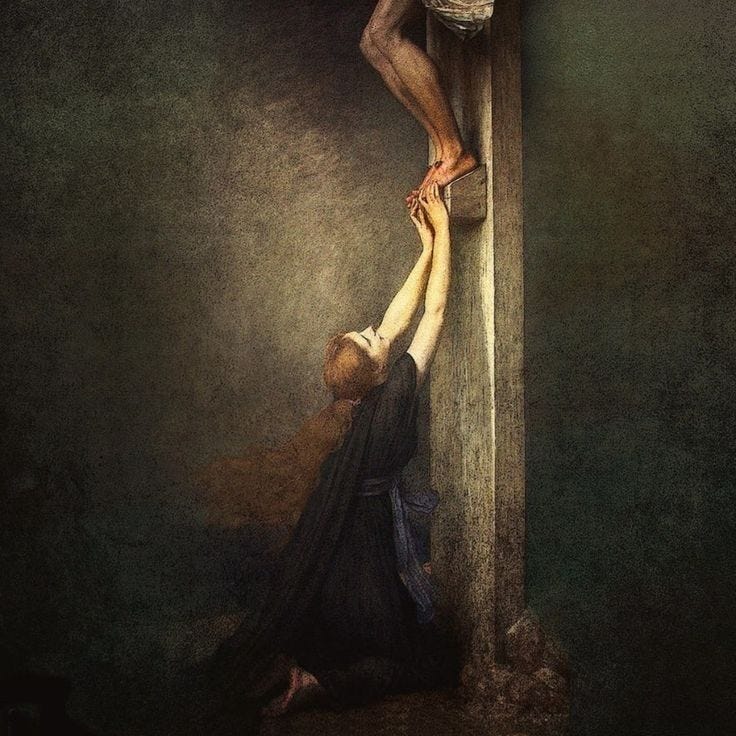
They lifted Him between earth and sky,
as though love itself
had been stretched to its furthest reach.
The wood received His weight.
The sky grew still.
And the One who shaped the dust of man
let dust cling to His wounds.
A crown of thorns pressed into His brow,
the ground’s ancient curse
resting upon the Gardener
who came to make all things new.
The thorns did not silence Him.
They only crowned His mercy.
His hands were opened,
not closed in defense.
Opened as they had been
when He blessed the children,
when He broke the bread,
when He raised the dead.
Now opened wider still–
to hold the weight of the world.
His feet, once walking upon the sea,
stood fasted upon the hill.
He did not step down.
Love kept Him there.
From His side flowed
an abundant and overflowing river–
a doorway in His flesh,
where mercy met our thirst.
As it is written:
“They will look on Him whom they have pierced.”
(Zechariah 12:10)
He was wounded for our transgressions,
crushed for our iniquities;
and by His wounds we are healed.
(Isaiah 53:5)
This is not the triumph of power,
but of surrender.
Not the shout of conquest,
but the whisper: “It is finished.”
(John 19:30)
And in those wounds
love made itself visible,
not as a symbol only,
but as a body broken
so that ours might be made whole.
The Parlor Shelf
Here are a few of my favorite articles from the past week that I saved:
A reflective and quietly funny piece on personal style, this essay traces one woman’s evolution from early blogging-era outfit posts to a more grounded, self-aware approach to getting dressed. I appreciated how Kali Ramey Martin holds together both truths—that appearance doesn’t define our worth, and yet caring for how we present ourselves can meaningfully shape how we show up for others. Her idea of “West Coast Classy,” blending practicality with timeless ease, feels less like chasing trends and more like settling into a style that honors real life, changing seasons, and a deeper sense of self.

Engaging some of the most difficult questions in Philosophy of Religion, this essay wrestles with divine hiddenness, hell, and salvation through a distinctly Catholic lens. I appreciated how Petrus refuses easy answers, instead tracing a careful path through thinkers like J. L. Schellenberg, Thomas Aquinas, and Edward Feser to argue that God’s apparent absence doesn’t undermine His goodness so much as reveal the limits of our expectations.

Rooted in Christ’s words about “abundant life,” this piece reframes abundance away from excess and toward deep, cultivated contentment. I was struck by how it names discontentment as a defining restlessness of our age, then counters it with a vision of joy found in the ordinary: coffee, clean sheets, shared love, and daily rhythms.

Thank you so much for reading!! If you enjoyed this and would like to support my work, tapping the heart helps my writing find its way to others. I’d also love to hear your thoughts in the comments.
God bless you, and see you in the next one!
— Victoria ♡
This is absolutely stunning- thank you for sharing this with us
my heartttt!!!! beautifully written